Monitor
Answer Engine Insights
Track your AI visibility, see where and how AI mentions your brand, and uncover insights to enhance your presence.
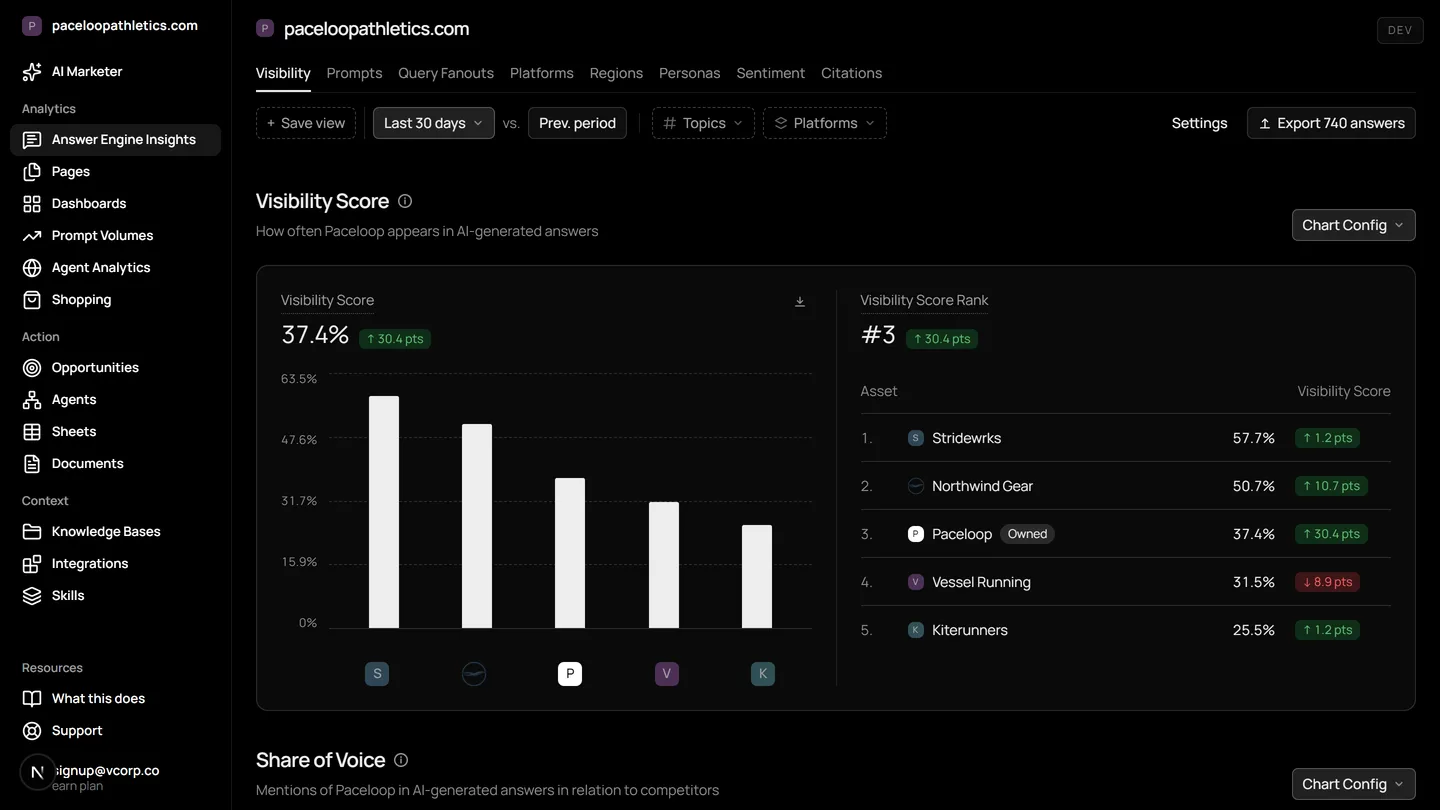
An AI visibility platform tracks how often and in what context your brand appears in AI-generated answers from tools like ChatGPT and Google AI Overviews. Mentionry is one such platform, recording the full text of these answers daily, showing you which pages the AI cited, and calculating your visibility score and share of voice against competitors.
Understand and control your AI presence
Track your presence
See how often your brand appears in AI answers, with visibility score and share of voice metrics, per engine, per topic and per persona.
Analyze AI responses
Understand what AI is saying about your brand and topics. Every answer is kept in full, so a point on a chart opens to the words the model actually used.
Uncover citations
Find out which websites drive AI's answers about you, and which ones a competitor is cited on while you are not.
Daily visibility runs
AI platforms do not return the same answer twice. Every tracked prompt runs daily, so your visibility score reflects your true average across responses.
Answers straight from the source
Responses are captured from the consumer product where the transport allows, not only the API, so what you see is what your customers see.
Where it lives in the platform
In the product it is /dashboard/answers. On the trial it reads your own site from the first day; on Starter it keeps going, and on Enterprise it runs for every brand you have under one login.
What an AI visibility platform is for
An AI visibility platform measures how your brand appears within AI generated answers. When a buyer asks ChatGPT, Google AI Overviews, Gemini, or Perplexity what to buy, the answer is a paragraph citing a handful of sources. Your goal is to be named in that answer and to have your content cited as the source. This category exists because traditional search visibility, tracking ten blue links, does not apply to a single, consolidated AI response.
Tracking this new form of visibility tells you if you are part of the conversation AI is having with your customers. It shows you which of your pages the engines are reading and trusting, and which of your competitors they prefer instead. Without it, you are marketing in the dark, unaware if your content is being used to train the answers that drive purchases.
Why AI search changes visibility
In traditional search, visibility is spread across many positions on a results page. In AI search, visibility is binary: you are either in the answer or you are not. There is no number two spot. The answer engine's single response is the entire results page.
This makes the cited sources critically important. If your page is not among the three or four links the AI provides, you are absent from the transaction. An AI visibility platform like Mentionry shifts the focus from ranking keywords to earning citations. It measures your success by how often you are named and linked within the AI's generated text, not by your position in a list.
How Answer Engine Insights works
You start by adding the questions you want to track, such as 'best CRM for startups' or 'sustainable running shoes'. Mentionry submits each prompt to the AI engines on your plan once per day, capturing three separate responses per reading to account for variability. It stores the complete answer text every time.
The main dashboard at /dashboard/answers shows your visibility score, which is how often your brand is named across all responses. You see your share of voice compared to competitors also named in those answers. Charts break this down by engine, topic, region, and customer persona. Every data point on a chart opens to reveal the exact words the AI used.
A key view is Citations. Here, you see every URL the AI referenced. Mentionry splits these into owned domains, operated profiles like your LinkedIn page, and earned mentions from other sites. You can instantly see which pages are driving your AI presence and, in competitive benchmarking, which sites are citing your rivals but not you.
How to use it in your week
On Monday, open your main Answers dashboard. Filter by the past seven days and look at the visibility trend for your core product topic. A steady decline is your cue to open the Citations view for that topic and see which source pages have entered or left the AI's responses.
Mid week, check Competitive Benchmarking. Select your main competitor and compare share of voice for a key prompt. If they are leading, click into the detail to see which specific websites the AI is citing for them. This list is a direct brief for your content or outreach team, identifying the publishers whose work is currently authorizing your competitor's place in AI answers.
Before a campaign launch, add a new prompt tracking the exact question you are targeting. After launch, monitor its dedicated visibility score. You will see in real data whether the AI is starting to incorporate your new content into its answers, or if you need to adjust your approach.
How to read the numbers
A rising visibility score means the AI is mentioning your brand in a higher percentage of its generated answers for your tracked prompts. This is a positive signal that your content is relevant and cited. A falling score suggests the AI is finding alternative sources it deems more authoritative, or that your competitors are producing more cited content.
Remember that these numbers reflect only the prompts you have chosen to track. They are not a measure of all AI search. A high share of voice against one competitor does not mean you dominate the market, only that you are mentioned more often than that specific rival in the specific answers you are monitoring. Nothing here is promised about future traffic or conversions.
The average position metric shows where your brand tends to appear within the AI's answer text, like first, third, or last. This can indicate prominence, but being named at all remains the primary victory. Sentiment analysis describes how the AI characterizes your brand, such as 'affordable' or 'enterprise grade', based on the language in its responses.
What it does not do yet
Answer Engine Insights provides a detailed record of your tracked prompts. It does not yet offer proactive, unprompted alerts. You must set up a scheduled agent to monitor for specific changes, like a sentiment drop, and notify you.
The platform measures visibility based on your configured questions. It does not have a panel of assistant users, so it cannot show you the volume of questions real people are asking AI on these topics. The Prompt Volumes feature provides estimates based on traditional search data, but this is marked as partly live for that reason.
It records what the AI engines output. It does not place, publish, or pay for links to influence these outputs. Influencing your visibility is a separate process that involves creating citable content and pursuing opportunities, which you manage through other parts of the Mentionry platform.
Plans and engines
The feature is live on all plans. You can try it free for seven days on your own site, tracking 50 prompts a day through ChatGPT, Gemini, and Google AI Overviews. The trial requires no credit card and ends automatically.
The Starter plan costs $99 a month. It includes daily readings on those three engines, tracking for one brand, and exports of all your data. The Enterprise plan is quoted based on your needs. It can include readings from up to nine answer engines, such as Claude and Perplexity, and covers every brand under your organization.
Recording begins the day you add a prompt. There is no historical backfill. If your brand is never mentioned in the AI's answers, your average position is not a high number, it is simply not applicable. You build the record forward from the day you start.
Questions
ChatGPT, Gemini and Google AI Overviews on the trial and on Starter. Enterprise adds Perplexity and Google AI Mode, which record today, with Microsoft Copilot, Claude, Grok and DeepSeek on the quote as their transports land.
Get your brand mentioned by the answer engines
Reach millions of consumers who are using AI to discover new products and brands. The first 7 days are free and take no card; Starter is $99 a month after that, and Enterprise is tailored.