Monitor
Prompt Tracking
Design and upload your own prompts, tailored to your brand, your products and the topics you want to own, and run every tracked prompt daily so your visibility score reflects your true average across all responses.
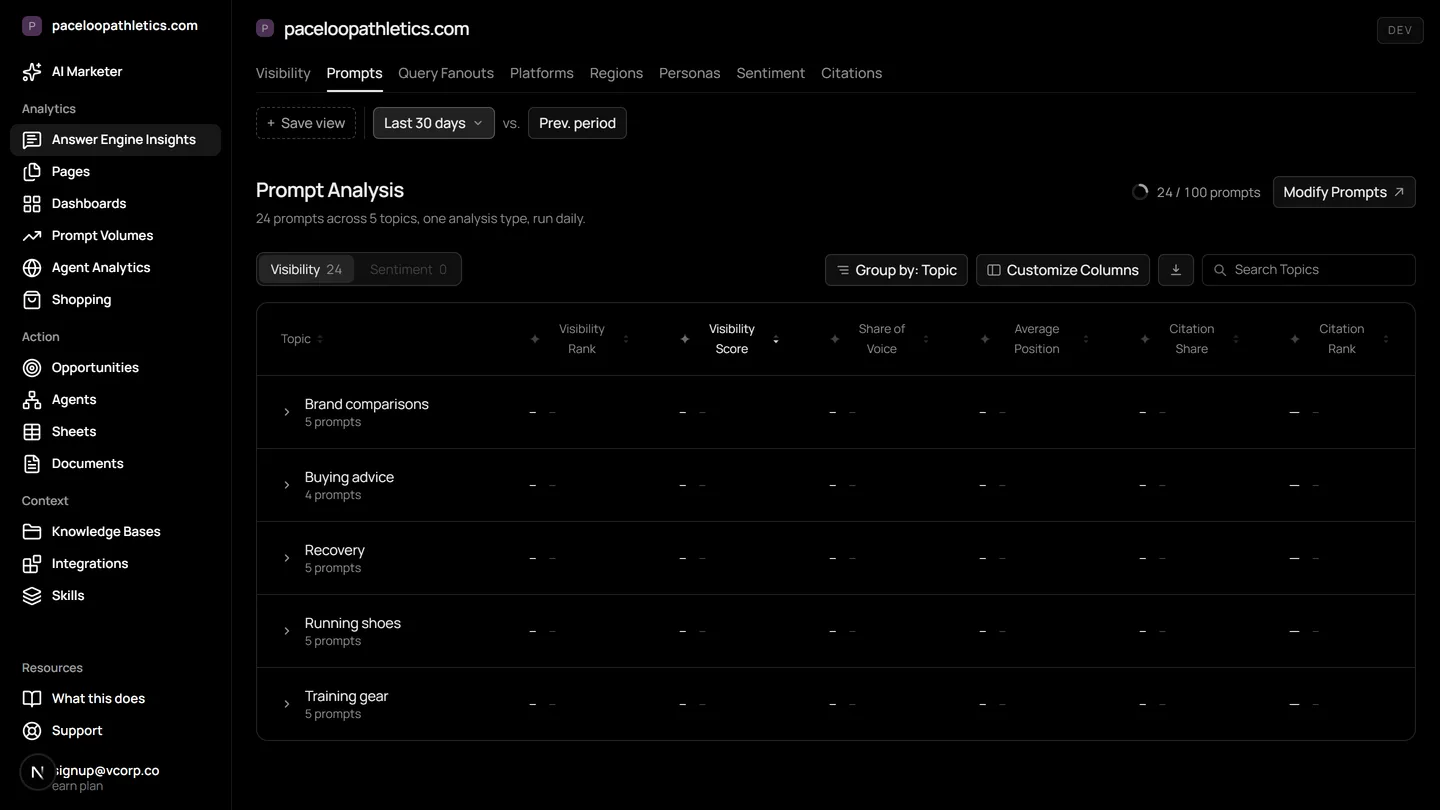
AI prompt tracking is the practice of systematically asking AI answer engines the questions your buyers ask and recording what they say about your brand. Mentionry is an AI marketing platform that does this: you write the prompts, it runs them daily on engines like ChatGPT and Google AI Overviews, and it keeps every answer, citation, and brand mention to show your visibility, share of voice, and sentiment.
Understand and control your AI presence
Custom and real-world prompts
Design and upload your own prompts, tailored to your brand, your products and the topics you want to own, or start from the questions setup drafts from your site.
Topics, tags, personas and regions
Organize prompts by topic and persona, and ask them from a region and in a language. The engines answer a founder and a procurement lead differently, and both are readings here.
A history per prompt
Open any prompt and read every response ever recorded for it: the brands named, the position you held, the sources cited.
Daily runs, within a spend ceiling
Every plan runs its prompts daily inside a daily spending stop counted in dollars, so a runaway loop cannot run up a bill.
Where it lives in the platform
In the product it is /dashboard/prompts. On the trial it reads your own site from the first day; on Starter it keeps going, and on Enterprise it runs for every brand you have under one login.
What AI prompt tracking is and why you need it
AI prompt tracking is a category of measurement for marketing in answer engines. It means recording what happens when someone asks an AI like ChatGPT, Gemini, or Google AI Overviews a question about what to buy. The engine's single answer, built from citations, replaces the traditional list of ten blue links. Your brand is either in that answer and its sources, or it is absent from the conversation.
This matters because your buyers are asking these engines for advice. If you do not know what the engines are saying about you, you cannot know why you are losing deals or where to improve your content. Tracking these prompts is the first step to managing your AI visibility.
How prompt tracking works for AI search
In traditional search, you track a keyword and your ranking for it. In AI search, you track a prompt and the entire answer generated for it. The output is not a position but a narrative that includes your brand, your competitors, recommendations, and the specific web pages the model used to construct its reply.
This shifts the focus from ranking to presence and narrative. A prompt tracking tool must capture the full text, every citation URL, every named entity, and the sentiment of the description. It must also show which of your own pages were opened and cited by the model, and which were ignored. This is the data that informs answer engine optimization.
How prompt tracking works in Mentionry
In Mentionry, you go to the Prompts dashboard. You write or upload the exact questions your customers ask. You can tailor them to your products, your brand, and the topics you aim to own. Each prompt can be tagged with a topic, a persona like 'founder' or 'procurement lead', and a region and language setting.
Mentionry runs each of your tracked prompts once per day. For each run, it takes three samples from the answer engine to account for variability. It records the complete answer text, every URL the model cited, every brand name mentioned, and the searches the model performed internally, known as the query fan out. All this data is stored in a history for that prompt.
Your visibility score, share of voice, sentiment, and citation analysis are all calculated from these daily readings. The system operates within a daily spending limit, measured in dollars, to prevent a runaway process from incurring unexpected costs.
How to use prompt tracking in your week
A typical workflow starts with setup. For a brand selling project management software, you might add prompts like 'best tools for agile teams', 'Asana vs. Monday.com', and 'how to manage remote project timelines'. Tag these under the topic 'project management' and the persona 'team lead'.
Each morning, open the Prompts dashboard. Filter to see yesterday's results for the 'project management' topic. Look at the visibility score trend. Click into the 'Asana vs. Monday.com' prompt to read the three answer samples from ChatGPT. Note if your brand was named, in what position, and which of your blog posts or case studies were cited. If a competitor was recommended and you were not, note the sources the model used.
Later, use the Query Fan out data from that prompt to see the searches the AI performed. It might show the model searched for 'Asana reviews 2026' and 'Monday.com pricing'. This reveals the informational gaps your content needs to fill to be considered for a citation next time.
How to read the numbers and avoid traps
A change in your visibility score means the frequency of your brand's mention across your tracked prompts has changed. A drop could mean the engines are citing newer content or that a competitor released a strong piece. It is a signal to investigate, not a definitive verdict.
Average position is the mean position your brand occupied when it was mentioned. A best position is not recorded for prompts where your brand was never cited. Nothing here is promised. A high share of voice is good, but check the sentiment: being named frequently in a negative context is worse than not being named.
Remember that Mentionry only measures the prompts you track. It cannot see what every potential customer is typing into ChatGPT. Your set of prompts is a model of the market conversation. If you do not track a relevant question, you will not see your performance for it.
What prompt tracking is not and what is partial
This is not a tool for tracking every possible user query. It is a tool for measuring performance against the questions you define as important. There is no backfill of historical data before you add a prompt.
The Prompt Volumes feature, which estimates real search demand around your topics, is partial. It uses search data to model potential assistant usage, not a live panel of assistant users. Shopping visibility within AI answers is also a partial measurement at this time.
Proactive alerts for events like a sentiment drop are not built as standalone notifications. You create these through scheduled agents that you set up and control.
Plans and access for prompt tracking
Prompt tracking is live on every Mentionry plan. The free trial runs for seven days on your own site with no credit card. It allows 50 prompts per day put to ChatGPT, Gemini, and Google AI Overviews.
The Starter plan is $99 a month. It includes 50 prompts, read daily on those three engines, for one brand. The Enterprise plan is quoted individually. It covers multiple brands under one login, access to up to nine answer engines including Claude and Perplexity, more prompts, configurable regions and languages, and additional seats. Recording begins the day you add a prompt.
Questions
Yes. Add, edit and remove prompts on the Prompts screen at any time, inside your plan's allowance.
Get your brand mentioned by the answer engines
Reach millions of consumers who are using AI to discover new products and brands. The first 7 days are free and take no card; Starter is $99 a month after that, and Enterprise is tailored.