Monitor
Regions & Personas
See how your presence shifts across regions, languages and audience personas, on the same prompts, side by side.
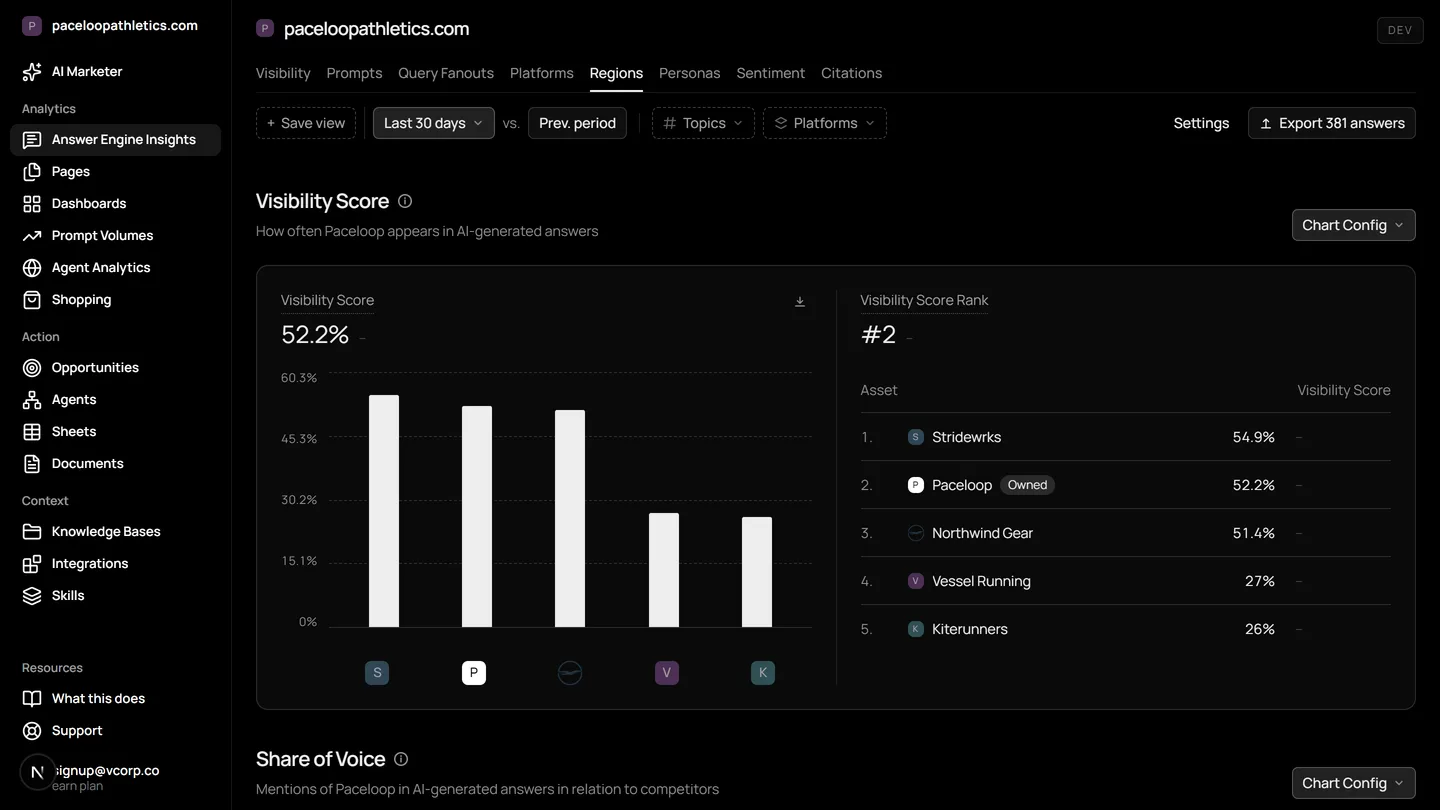
AI search visibility by country means tracking how often your brand is named in AI answers like ChatGPT and Google AI Overviews across different markets. Mentionry reads the same prompts daily in multiple regions and languages, showing you where your presence is strongest and where buyers in different personas get different recommendations, all from a single dashboard.
Understand and control your AI presence
Regions and languages
Set the region and language at setup and change them later. Enterprise tracks several at once, so a brand sold in five markets reads all five.
Audience personas
Two personas on Starter, twelve on Enterprise. Each gets its own readings and its own column, so the difference between buyers is the finding.
Where it lives in the platform
In the product it is /dashboard/regions. On the trial it reads your own site from the first day; on Starter it keeps going, and on Enterprise it runs for every brand you have under one login.
What is AI search visibility by country
AI search visibility by country is the measure of how often and how well your brand appears in the answers generated by AI engines like ChatGPT, Google AI Overviews, and Gemini for users in specific geographic markets. It matters because a buyer in Paris and a buyer in Tokyo may ask the same question but receive different answers, each shaped by local context, language, and the sources the AI deems relevant. In traditional search, you tracked rankings for keywords in each locale. In AI search, you track citations, mentions, and sentiment within the generated answer itself, knowing that a single paragraph can decide a purchase.
Why regional and persona tracking changes with AI answers
When search was a list of links, a page could rank globally. An AI answer is a synthesis, and its sources are chosen with a point of view. ChatGPT may cite a prominent US tech blog for a user in New York, but reference a German trade publication for the same query from Berlin. Furthermore, the AI tailors its tone and recommendations based on who it perceives is asking. The answer to 'best project management software' will differ for a freelance graphic designer versus an enterprise IT director. Localised AI search tracking is therefore about understanding these dual layers of bias: the geographic and the personal. You are no longer just optimizing for a keyword, but for a context.
How Mentionry tracks AI answers by region and language
In Mentionry, you write the questions your buyers ask. The platform then puts each prompt to the configured AI engines, such as ChatGPT, Gemini, Google AI Overviews, Claude, and Perplexity, once per day. For regional tracking, it queries the specific regional context of those engines. All answer text, every cited URL, every named brand, and the model's internal search steps are recorded.
These readings are organized on the Regions dashboard. You see your core metrics, visibility score, share of voice, and sentiment, segmented by each region and language you track. A second view splits the data by your configured audience personas, placing the readings for each persona in adjacent columns. This lets you compare not just France versus Canada, but how the AI advises a budget-conscious buyer versus a premium seeker in the same country.
- Regions and languages: You set a geographic region and a language for your prompts. The Enterprise plan allows tracking up to five region-language pairs concurrently.
- Audience personas: You define audience personas with a short description. Starter includes two, Enterprise up to twelve. Each persona gets its own column of daily readings.
Workflows for AI visibility by persona and region
Open the Regions dashboard at the start of your week. Filter to view last week's data for your key competitor in the UK region. Look for a shift in sentiment or a new publication citing them that doesn't cite you. This signals a local PR or content gap.
Compare the 'IT Manager' persona column against the 'Marketing Lead' persona for your top product prompt. Note which of your own help articles or case studies each persona's answers cite. If the Marketing Lead receives answers citing your high-level whitepaper, but the IT Manager gets answers citing a competitor's technical spec, you have a content alignment opportunity.
Set a scheduled agent to run every Monday. Have it check the visibility score for your brand in the DACH region (German language) versus the US. Configure it to post a summary to your team's Slack channel if the delta grows beyond a point you set. This automates the oversight of your global AI presence.
How to read the numbers and avoid traps
A rising visibility score in a region means the AI is naming you more often in its answers there. Check the citations to see if it's your global homepage or a locally relevant page driving the increase. A falling score may not mean you've lost ground, it could mean the AI is synthesizing answers differently, perhaps naming fewer brands overall.
Differences between personas are the finding. If you are mentioned for 'ease of use' to the small business persona but for 'security features' to the enterprise persona, your messaging is landing as intended. If you are absent from one persona's answers entirely, the AI does not associate your brand with that audience's needs. Remember, these readings are from the prompts you track. They reflect your chosen slices of demand, not every possible question in the market.
What regional and persona tracking is not
This is not a panel data tool. The prompt volumes you see are estimates based on related search data, not a direct feed of what millions are typing into ChatGPT. The feature shows you how the engines answer for your defined contexts, not how often those contexts are queried.
There are no specific limits on the number of daily readings per region or persona beyond your overall account prompt limit. The data recording begins when you add a prompt for a region or persona, there is no historical backfill.
Plans and access for localised AI search tracking
The trial is free for seven days and includes this feature. You can track one region and language with two personas, putting 50 prompts daily to ChatGPT, Gemini, and Google AI Overviews.
The Starter plan, at $99 a month, expands on this with exports and more agent runs, but keeps the one-region, two-persona scope. The Enterprise plan is quoted individually. It allows tracking up to five regions and languages simultaneously, with up to twelve audience personas, from ten seats, with API access and SSO. Enterprise also includes access to more answer engines.
Questions
One region and one language on Starter. Enterprise sets the count on the quote.
Get your brand mentioned by the answer engines
Reach millions of consumers who are using AI to discover new products and brands. The first 7 days are free and take no card; Starter is $99 a month after that, and Enterprise is tailored.