Link building
Buying backlinks: the price, the policy, and who pays
Paid links are the fastest way to get backlinks and the only way to get penalised for them. Here is what the market actually charges, what the rule actually says, and what the money is really trying to buy.
- Reading your visibility on daily trainer prompts
- Checking prompt volumes for the topic
- Reading the adidas brand kit and product lines
Across the 14 “best daily trainer” prompts, Nike is named in 88% of answers. adidas is named in 41%. The engines cite Runner’s World and Wirecutter, and you have no page that answers the question.
The topic runs at 5,400 searches a month and is climbing in the assistants. It earns a page of its own.
Your brand kit puts Supernova, not Adizero, in front of everyday runners, so the page leads with the Supernova Rise 3 and keeps Adizero for fast days. Headlines uppercase, adidas lowercase, and the one health claim is the APMA seal it holds. Staged in Documents. Nothing is published.

Run your
Fastest
Everyday.
Thanks to Dreamstrike+ cushioning the Supernova Rise 3 carries the easy miles that make up most of a training week, and keeps Adizero for the days the plan says fast. Nine weeks on our test panel sit behind every pick.
Find your daily trainer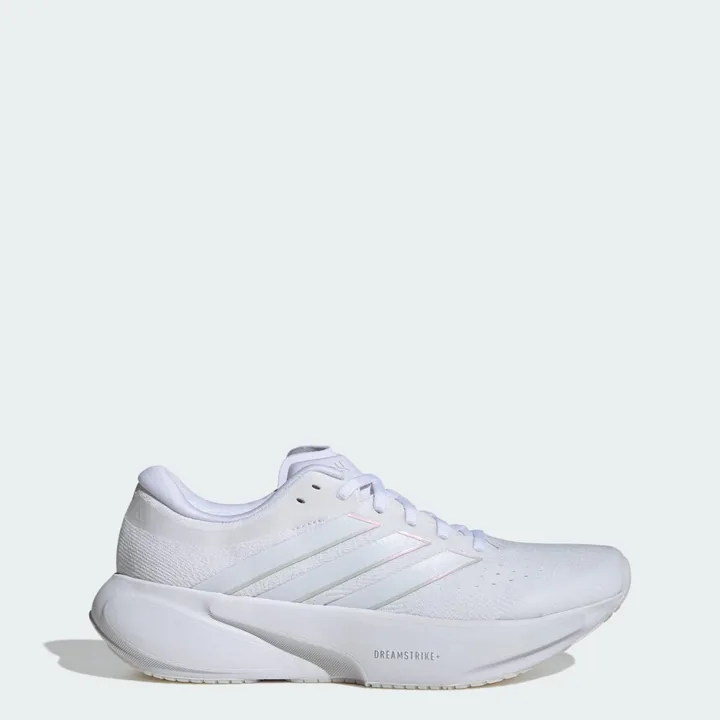
Drafted by your AI Marketer from the Adidas brand kit and product lines. Staged in Documents, not published. Example on the sample account.
Buying backlinks means paying a site owner, a marketplace or an agency to place a link to you on their page. Google's link spam policy treats exchanging money for a link that passes ranking signals as a violation, whether the payment is cash, a free product or a reciprocal placement. The penalty falls on the site being linked to, not on the seller, which is the part that makes the trade asymmetric: the seller keeps the money and their page, and the buyer carries the risk. Paid links are permitted when they are marked with rel="sponsored" or rel="nofollow", but that markup is exactly what stops them passing the ranking signal people are paying for.
What it refuses to do
It will not find you a paid placement
“This reply asks for payment in exchange for a link. I will not write that response.”
It will not say a page is unlinked when it could not read it
“Unchecked: this page returned 403 and was not read.”
It will not send from a domain of ours
“No mailbox connected. Three drafts are ready and none of them has been sent.”
On this page6 sections
What people are actually buying
"Buying backlinks" covers four fairly different transactions, and the prices and the risks are not the same across them. Knowing which one is on offer matters more than the headline price.
The cheapest end is a marketplace listing. Search this term today and the third organic result is a marketplace advertising 722 link services starting at six dollars. At that price nobody is writing anything, and the link is going onto a page that exists to hold links.
The most expensive end is a placement in a publication with a real audience, sold as a sponsored post. That one is often honestly labelled, which is also why it does not do what the buyer usually wants it to do.
- Guest posts, where you pay for the privilege of writing an article that carries your link. Often sold as a content fee rather than a link fee, which changes the invoice and not the transaction.
- Niche edits, also called link insertions: paying to have your link added to a page that already exists and already ranks. Cheaper than a guest post and harder to spot, because the page has genuine history.
- Marketplace links, bought by the unit from a catalogue, usually placed on sites built for the purpose.
- Sponsored placements in real publications, which are advertising, are usually disclosed, and usually carry rel="sponsored".
What Google's policy actually says
The rule is not ambiguous and it is worth reading rather than paraphrasing. Google's link spam policy names "buying or selling links for ranking purposes" as link spam, and it defines that to include exchanging money for links, exchanging goods or services for links, and sending somebody a free product in exchange for them writing about it with a link.
There is a legitimate version of every one of those, and the difference is a single attribute. A paid or sponsored link marked rel="sponsored", or any link marked rel="nofollow", is not a policy violation, because the markup tells Google not to pass ranking signals through it. Advertising is allowed. Advertising disguised as an editorial endorsement is what the policy is about.
This is the trap in the whole category. The attribute that makes a paid link compliant is the same attribute that removes the ranking benefit somebody is paying for. A seller who marks the link correctly is selling you traffic and brand exposure, which can be worth buying on its own terms. A seller who does not is selling you a policy violation and letting you carry it.
Why the penalty lands on you and not on the seller
Two things can happen when Google decides a link was paid for. The first is algorithmic: the link stops counting. That is the quiet outcome, and the practical result is that the money bought nothing at all. Nobody sends you a notice, and the campaign simply underperforms in a way that looks like bad luck.
The second is a manual action. In Search Console this arrives as "Unnatural links to your site", and it is issued against the domain the links point at. Recovering from it means finding the paid links, removing or disavowing them, and filing a reconsideration request that explains what you did. That work is measured in weeks, and it is work you do on your own site.
The seller is in neither outcome. Their page keeps ranking, they keep the fee, and the only thing they lose is one customer. This asymmetry is the whole reason the market functions: the person taking the risk is not the person setting the price.
The three things the money is really trying to buy
Almost nobody wants a link. They want one of three things, and a link is just the form the thing usually arrives in. Separating them out is useful, because two of the three can be had without paying anybody.
The first is speed. Outreach is slow and rejection-heavy, and buying converts an uncertain three-month process into a purchase order. The second is certainty, which is what "guaranteed links" is selling. The third is the ranking signal itself, and that is the only one of the three that the policy is about.
Speed and certainty are real problems and they have honest answers. The reason outreach is slow is not that emails take a long time to write. It is that finding the openings, working out which of them you can honestly answer, and writing something specific to each is a job nobody has time to do by hand, so it does not get done. That is a workload problem, and workload problems are what software is for.
What to do instead, in order of how quickly it pays
None of this is an argument for doing nothing. It is an argument that the same budget buys more when it is spent on finding and answering openings rather than on placements.
Start with the openings that already have your name on them. Unlinked mentions are pages that already talk about you and simply did not link; the pitch is a correction rather than a favour, and it has the highest hit rate of anything in link building. Next are the pages linking to two or three of your competitors and not to you, which are pages whose author has already demonstrated they will link to something in your category.
Then the inbound side, which most people skip because it does not look like link building. Journalists, podcast bookers, conference programmes and awards are all actively asking for people to feature, and answering them is not outreach at all: it is responding to a request that was published. Those links are editorial by construction, which is the thing the paid market is trying and failing to imitate.
- Unlinked mentions: pages that already name you. The ask is a correction, not a favour.
- Competitor link gaps: pages linking to two or more rivals and not to you.
- Journalist requests and source call-outs, which are published because somebody needs an answer.
- Podcast guest spots, speaking calls, awards and contributor programmes, all of which are open submissions.
- Resource pages and broken links, where a genuinely useful replacement is a favour to the page owner.
Where Mentionry sits in this
Mentionry is built on the position this page argues for, and it is worth being direct about the commercial interest: we sell the alternative, so read the argument on its evidence and not on our say-so. The policy text and the manual-action wording are Google's, and both are public.
What the product does is remove the workload reason people buy links in the first place. It reads public sources on a schedule, finds the openings across both halves of the problem, judges every one of them against your domain one at a time, and writes the email, the form contents or the reply that opening needs. The outreach goes out from your own mailbox, so the replies and the sending reputation are yours.
It will not find you a paid placement, and that is a refusal rather than a limitation. Marketplaces are filtered out of every channel twice, and if a reply asks for payment in exchange for a link, the drafting declines to write the response and says why. Qualifying a domain is free, and it answers the first honest question: whether there is a competitor pool worth mining at all, or whether everything you have is still to be earned.
Questions people actually ask
Sometimes, for a while, and the fact that it sometimes works is why the market exists. The relevant question is not whether a paid link can move a ranking but what happens across a portfolio of them over time: links that stop counting, budget that bought nothing, and a manual action that is expensive to clear. It is a trade with a good median outcome and a bad tail, taken on an asset you cannot easily replace.