Monitor
Competitive Benchmarking
Compare your visibility, citations and share of voice against the competitors you name, on every prompt and every platform.
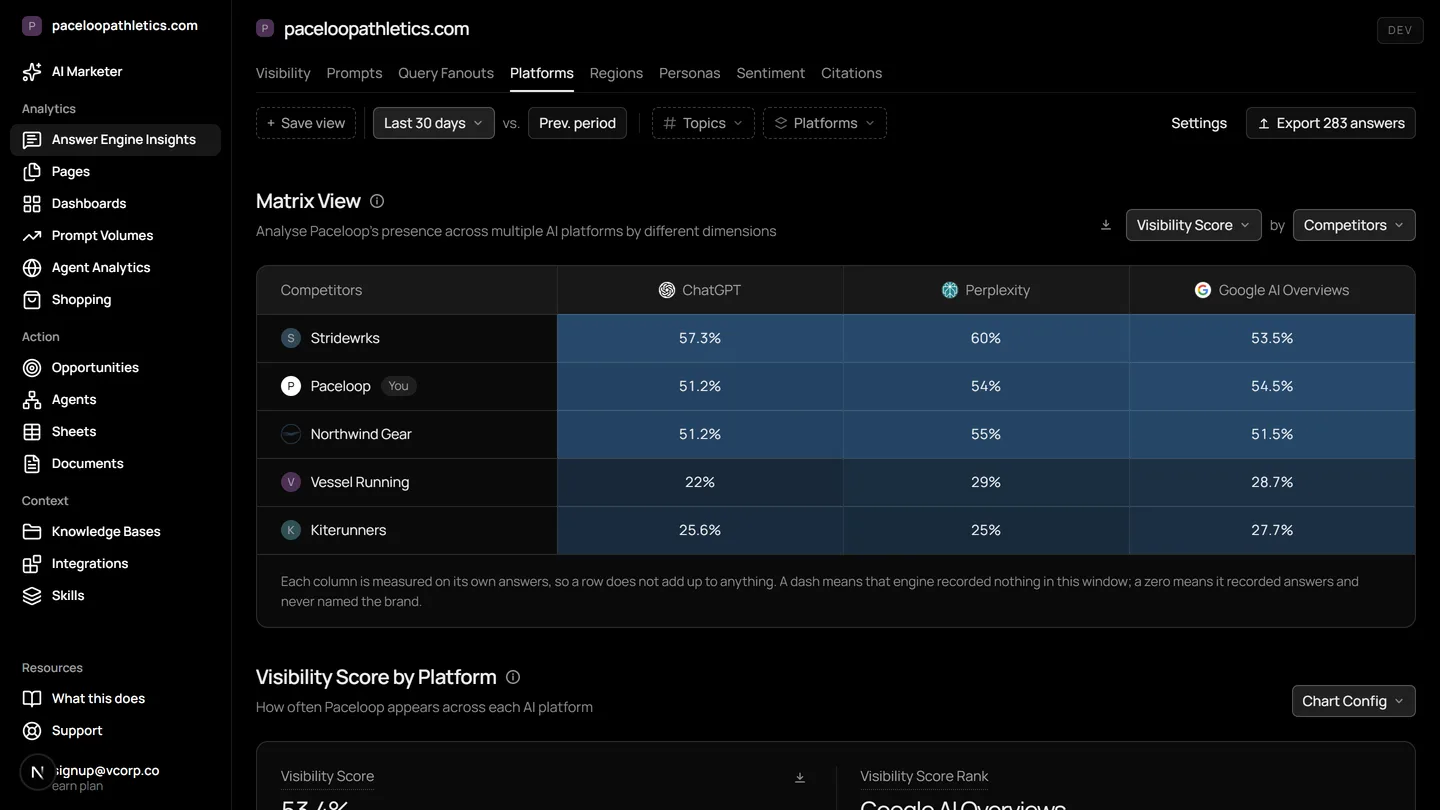
AI search competitor analysis is the practice of tracking how often your brand and its competitors are named in the answers from ChatGPT, Gemini, Google AI Overviews, and other AI assistants. Mentionry records these mentions daily across the questions your buyers ask, showing your visibility rank, share of voice, and which topics each competitor leads on, so you can see where you stand in the AI-driven conversation.
Understand and control your AI presence
Visibility rank
Your position among the brands the engines name across your prompts, updated with every reading.
Head to head by topic
On which topics a given competitor beats you, and by how much. The shortest route to the content that would change the answer.
Unexpected names
Brands the engines keep naming that you did not list are surfaced from the readings, so the competitive set is what the engines think it is.
Where it lives in the platform
In the product it is /dashboard/competitors. On the trial it reads your own site from the first day; on Starter it keeps going, and on Enterprise it runs for every brand you have under one login.
What is AI search competitor analysis
AI search competitor analysis is the process of measuring how your brand stacks up against others in the answers generated by AI assistants like ChatGPT, Gemini, Google AI Overviews, Claude, and Perplexity. When a buyer asks 'what is the best project management software', the AI's single, authoritative answer will name a handful of brands. Your position in that list, and how often you appear compared to others, defines your competitive visibility in AI search.
This practice matters because purchase decisions are increasingly starting inside these answer engines. Unlike traditional search, where ten blue links offer multiple perspectives, an AI answer presents one consolidated view. Being named, described favorably, and cited authoritatively in that view is the new battleground for brand relevance.
Why competitor tracking changes for AI answers
The shift from links to answers changes what you need to measure. Share of voice is no longer about keyword rankings on a results page, it is about the frequency of brand mentions within a paragraph of generated text. A competitor beating you might not rank for more keywords, they might simply be described more comprehensively in the AI's answer on a key topic.
Benchmarking now means understanding which specific questions or topics trigger a competitor's mention over yours. It also means discovering unexpected competitors, the brands the AI engines consistently pair with you even if you do not consider them direct rivals. This reveals the true competitive set as defined by the AI's training and real-time search data.
How competitive benchmarking works in Mentionry
Mentionry's Competitive Benchmarking is built on daily readings from the answer engines on your plan. For each prompt you track, such as 'best CRM for small business', the platform records the full answer text and every brand name mentioned. Over time, it builds a database of mentions across all your prompts and all connected engines like ChatGPT, Gemini, and Google AI Overviews.
The feature lives on the Competitors dashboard. It shows three core analyses. Your Visibility Rank displays your position among all brands the engines name across your prompts, updated daily. Head to Head by Topic breaks down performance by subject, showing exactly which queries or themes a specific competitor is winning on and by what margin. Unexpected Names surfaces brands that are frequently mentioned alongside you but are not on your tracked list, helping you refine your competitive set.
How to use it in your week
Open the Competitors dashboard each Monday. Review your overall visibility rank movement from the previous week. A drop likely indicates a competitor was mentioned more frequently in answers to your core prompts.
Filter the Head to Head view by your main competitor and look for topics where their lead is largest. Click into a topic to see the exact prompts and answers where they were cited. This shows you the content gap: the questions where the AI finds their citations more relevant. Use this to brief your content team.
Check the Unexpected Names list monthly. If a new brand appears consistently, add them to your tracked competitors. Investigate which of their pages are being cited by the AI for topics you care about, using the Citation Tracking feature.
How to read the numbers
A change in your visibility rank means the distribution of brand mentions across your tracked prompts has shifted. Moving from 4th to 3rd means you are now mentioned more often than the previous 3rd place brand within the answers Mentionry collected. It does not mean you will appear in every answer a real user receives, as AI answers vary.
Share of voice is calculated from the brand mentions in your recorded answer set. If you have a 25% share, one in four brand names the engines mentioned across your prompts was yours. A high share on a low volume prompt is less significant than a moderate share on a high volume one. Use Prompt Volumes, where available, to gauge the real search demand behind each topic.
The main trap is assuming the data is universal. Mentionry benchmarks only against the answers to your specific tracked prompts. It does not see all conversations happening in AI assistants. The insights are powerful for your defined scope, but they are not a panel data representation of all AI search.
What it is not
Competitive Benchmarking in Mentionry is not a panel-based market share tool. It does not estimate what percentage of all AI assistant users see a brand. It analyzes the answers from your own tracked prompts.
It is not a backfilled historical analysis. Recording begins when you add a prompt. A brand never mentioned in your readings has no historical rank. The system shows you what is happening now and tracks change from that point forward.
The feature does not yet include automated alerts for rank changes. You can, however, build a scheduled agent in the AI Marketer to check your visibility rank daily and message you in Slack or email if it drops below a threshold.
Plans and platforms
Competitive Benchmarking is live on every Mentionry plan. The free seven day trial includes it, reading from ChatGPT, Gemini, and Google AI Overviews. The Starter plan at $99 a month continues with those three engines. Enterprise plans can include readings from up to nine engines, such as Perplexity and Claude, with the exact mix set on your quote.
The number of prompts you can track daily determines the volume of data for your analysis. The trial and Starter plan allow 50 prompts per day. Enterprise plans offer 400 prompts. You can track as many competitor brands as you need within those prompt limits.
Questions
As many as the engines name. The ones you list are ranked on every screen; the rest are surfaced from the readings and can be promoted with a click.
Get your brand mentioned by the answer engines
Reach millions of consumers who are using AI to discover new products and brands. The first 7 days are free and take no card; Starter is $99 a month after that, and Enterprise is tailored.