Monitor
Citation Tracking & Analysis
See which websites influence AI-generated answers about your brand, track their authority, and pinpoint the prompts where a competitor's content is cited and yours is not.
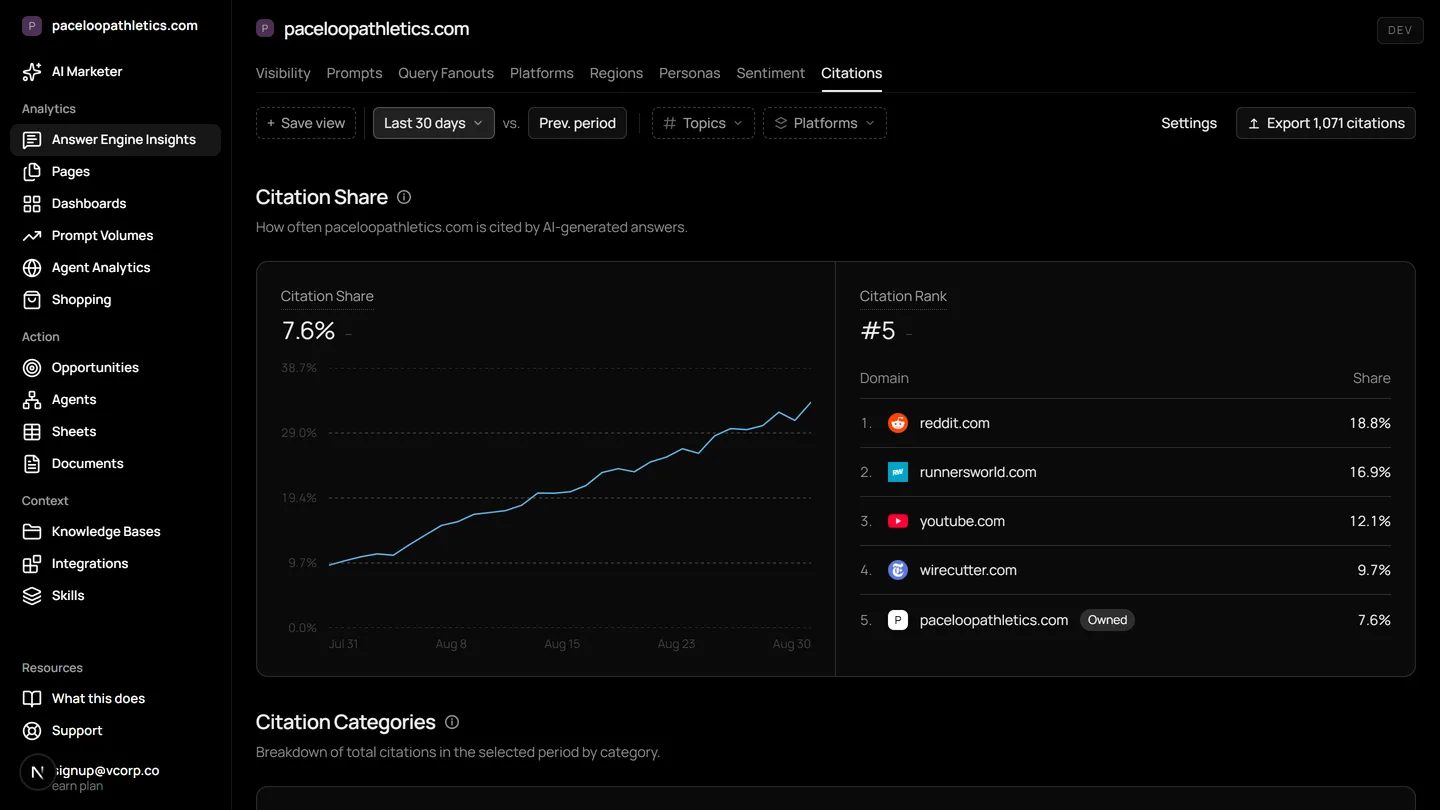
AI citation tracking is the process of monitoring which web pages ChatGPT, Gemini, Google AI Overviews, and other answer engines reference when generating answers about a brand or topic. Mentionry records these citations daily, showing you the exact sources AI uses to talk about you, your share of voice against competitors, and where you are missing from the conversation. This visibility is foundational for understanding and influencing AI search results.
Understand and control your AI presence
Citation authority
See which websites influence AI-generated answers about your brand, classified as owned, operated, competitor, earned media, social or institution.
Citation share
How much of the cited surface is yours against the competitors you track, on each engine and each topic, day over day.
Uncited prompt detection
Pinpoint the prompts where a competitor's content is cited and yours is not, segmented by page and topic.
Watched pages and exports
Pin any URL and see when it is cited and on which prompts. Export everything to CSV and JSON.
Where it lives in the platform
In the product it is /dashboard/citations. On the trial it reads your own site from the first day; on Starter it keeps going, and on Enterprise it runs for every brand you have under one login.
What AI citation tracking is and why it matters
AI citation tracking is the specific practice of monitoring which websites and pages are referenced by AI answer engines like ChatGPT, Gemini, and Google AI Overviews. When a buyer asks an AI assistant what to buy, the engine generates a paragraph or a list, citing specific URLs as its sources. These citations are the new form of visibility, replacing the traditional list of ten blue links.
This matters because the citation is the proof point. If an AI cites a competitor's blog post as the authority on a topic and does not cite yours, that competitor gains implicit trust. Tracking these citations tells you which of your pages are considered authoritative, which third-party sites are influencing perceptions, and where you are entirely absent from the AI's knowledge. It is the first step to being part of the answer.
How AI search changes the game for citations
In traditional search, visibility was spread across many positions on a results page. In AI search, the answer is often a single, consolidated response. Your brand is either mentioned and cited within that answer, or it is not. There is no position two through ten.
This consolidation makes each citation more valuable and each omission more costly. Furthermore, AI engines may run their own searches, a process called query fan-out, to gather information before synthesizing an answer. Tracking citations reveals this hidden research, showing you not just the final cited source, but the trail of pages the AI considered along the way. Understanding this path is unique to AI citation tracking.
How Mentionry tracks AI citations
Mentionry works by reading the answer engines for you. You add the questions your buyers ask, such as 'what is the best project management software for small teams'. Each of these prompts is put to the engines on your plan, like ChatGPT and Google AI Overviews, once per day. Mentionry records the full text of every answer, every URL cited within it, every brand name mentioned, and the searches the AI performed to build its response.
All this data flows into the Citation Tracking dashboard. Here, you see the raw citations, sorted by the website domain. Each citation is classified. Owned means your own website domains. Operated means profiles you control, like your company LinkedIn page or YouTube channel. Earned means everyone else, which is further broken into media, social platforms, institutions, or competitor sites. You can pin any specific URL to watch it and see exactly which prompts trigger a citation.
The key metrics: authority, share, and gaps
The dashboard turns raw citation data into three actionable metrics. Citation Authority shows you which websites are most influential in answers about your brand. A high-authority news site citing you is different from a niche forum doing the same.
Citation Share calculates how much of the cited surface area belongs to you versus the competitors you track. You can see this share by engine, by topic, and day over day. It tells you if you are winning the conversation. Finally, Uncited Prompt Detection automatically flags the specific prompts where a competitor's content was cited and yours was not. It segments these gaps by page and topic, so you know precisely what content is missing from the AI's knowledge base.
How to use citation tracking in your week
A typical workflow starts with the dashboard. Open the Citations screen each morning and filter by 'Earned' media for the past seven days. Look for new, high-authority domains that have started citing your brand. This signals growing third-party validation that you can amplify.
Next, go to the Uncited Prompt Detection list. Filter by a key competitor and a core product topic. Review the prompts where they were cited and you were not. For each, open the Pages screen to see if you have a relevant, high-quality page on that subject. If you do, its absence is a content gap for AI. If you do not, it is a content creation signal. Finally, export the weekly citation share report for your key product line to CSV and share it with your content team to show the direct impact of their work on AI visibility.
How to read the numbers and avoid traps
A rising citation share is a positive signal, but it is not a direct traffic metric. It means the AI is using your content more often as a source. A sudden drop in share on a specific engine, like Gemini, warrants investigation into what new content a competitor published that is now being cited.
Remember that Mentionry measures only the prompts you track. It cannot see what every potential customer types. The citation share is relative to the competitors you have chosen to monitor. If you do not track a fast-rising challenger, your share will look artificially high. Also, a citation is not a link in the traditional SEO sense. It is a reference within an AI's answer. The publisher's page does not need to link to you for the AI to cite it. Nothing here is promised, but the data provides a clear direction for your strategy.
What this feature does not do
Citation tracking shows you what the AI cited from the prompts you gave it. It does not proactively alert you to a sentiment drop or a new competitor citation unless you have set up a scheduled agent to check for those things. The feature classifies pages by domain type, but it does not perform a deep page-level authority score like some traditional SEO tools.
The data is based on daily readings of the engines you have access to on your plan. It does not include data from every AI model. For instance, tracking citations from Microsoft Copilot or Grok is not currently available. There is no backfill of historical data before you started tracking a prompt.
Plans and access to AI citation tracking
Citation Tracking & Analysis is live on every Mentionry plan. The free seven day trial includes it, reading from ChatGPT, Gemini, and Google AI Overviews. The Starter plan, at $99 a month, expands on this with daily readings on those three engines for one brand.
For larger teams needing to track multiple brands, the Enterprise plan is quoted based on needs. It can include readings from up to nine answer engines, such as Perplexity and Claude, across multiple regions and languages. All plans allow you to export citation data to CSV and JSON for further analysis.
Questions
By domain, against your own domains, the competitors you named, and a maintained list of publisher, wire, social and institutional domains.
Get your brand mentioned by the answer engines
Reach millions of consumers who are using AI to discover new products and brands. The first 7 days are free and take no card; Starter is $99 a month after that, and Enterprise is tailored.