Act
Outreach & Distribution
Tailor outreach to the authors of top-cited pages in your category. Every email drafted by your AI Marketer, approved by you, sent from your own Gmail.
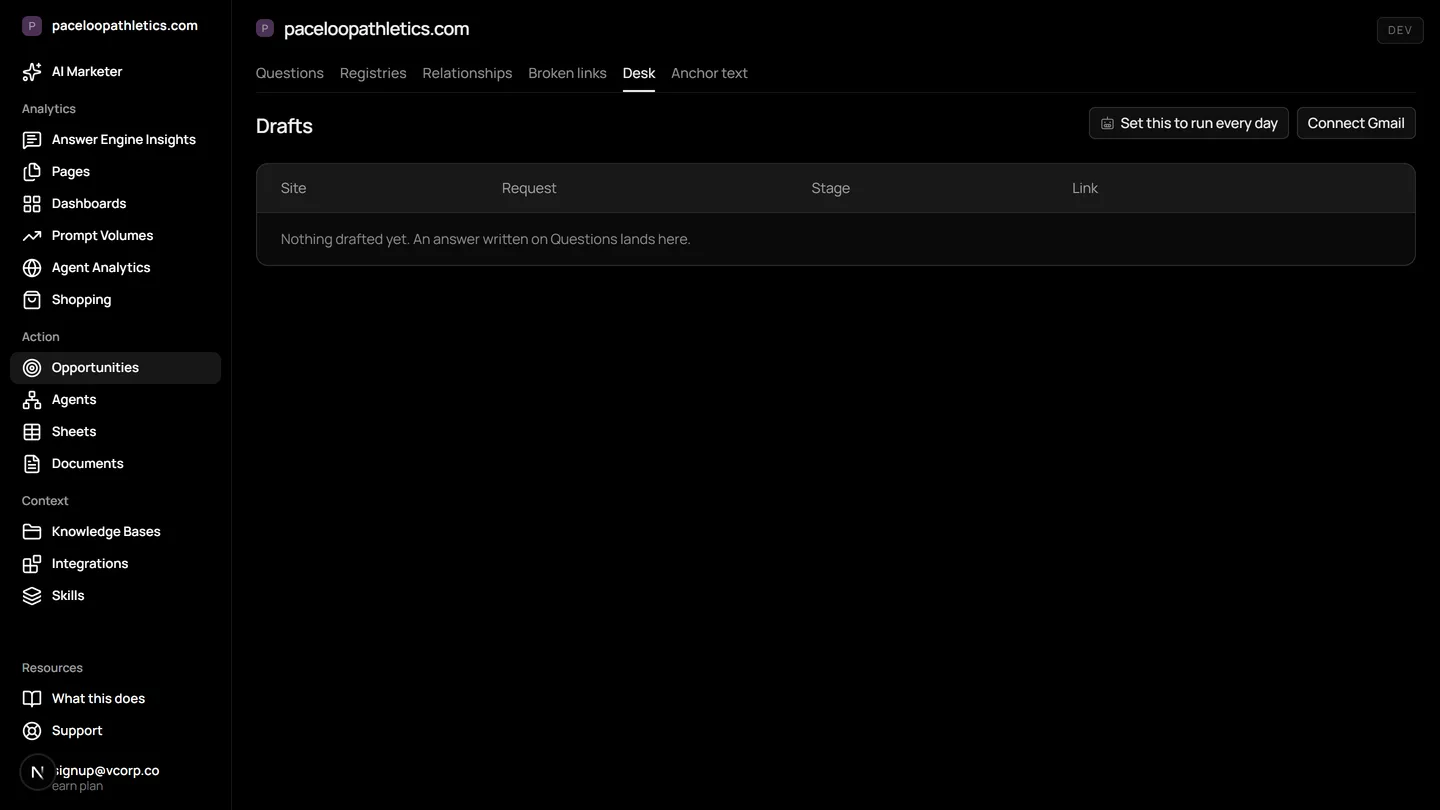
An outreach tool for AI search helps you earn citations in the pages that answer engines like ChatGPT and Google AI Overviews cite. Mentionry finds opportunities where your brand could be mentioned, drafts a tailored pitch for each, and lets you send it from your connected Gmail after you approve it. The goal is to increase your brand's visibility in AI-generated answers.
Understand and control your AI presence
Drafted, then approved
A pitch per opportunity, written by your AI Marketer against your brand kit and the specific page. Human-in-the-loop approval before anything is sent.
Sent from your own Gmail
Connect Gmail once. Pitches go from your address and replies land in your inbox.
Landed: what became a citation
Weeks later the desk checks every site you pitched against the engines' citations and records which ones landed.
Automation, once you trust it
Scheduled agents can run the loop on a cadence: find, draft, wait for approval, send, verify.
Where it lives in the platform
In the product it is /dashboard/desk. On the trial it reads your own site from the first day; on Starter it keeps going, and on Enterprise it runs for every brand you have under one login.
What an outreach tool for AI search is
An outreach tool for AI search is software that helps you earn media mentions, or citations, in the sources that answer engines read. Buyers now ask AI assistants what to buy, and those assistants answer with a paragraph citing a handful of web pages. If your brand is not in those cited pages, it is unlikely to be recommended.
Traditional digital PR outreach often aims for general brand awareness or domain authority. Outreach for AI search is more specific. It targets the authors and publications whose pages are already being cited by ChatGPT, Gemini, Perplexity, and others for questions in your category. The objective is to become a cited source within the AI's answer, not just to get a link for SEO.
This shift requires a different workflow. You need to know which pages the engines are reading, identify opportunities to contribute to those pages, and communicate your relevance clearly and quickly to the people who publish them.
Why outreach matters for AI search visibility
When search results were ten blue links, visibility was about ranking on page one. With AI search, visibility is about being named and cited in a single, generated answer. The engines construct these answers from the web pages they have read and deemed relevant. If your content is not part of that reading material, you are absent from the conversation.
Earned media, like expert quotes in a journalist's article or a case study in a roundup, is a primary fuel for these answers. A tool that helps you pitch journalists for AI search focuses on this earned layer. It connects your expertise to the specific topics and questions the engines are already answering, increasing the chance your brand becomes a trusted source the AI will reference.
This makes outreach a core part of answer engine optimization. It is not about gaming the system, but about legitimately contributing your knowledge to the publications that shape AI responses. Effective outreach for AI search is timely, relevant, and tied directly to the evidence of what the engines are citing.
How outreach and distribution works in Mentionry
The Outreach & Distribution feature, called the Desk, is part of Mentionry's Act module. It works alongside the Monitor module, which records what answer engines say about your brand daily. The Desk uses that data to find actionable opportunities and manage the outreach process.
First, the Opportunities screen lists places your brand could appear. This includes journalist requests, podcasts booking guests, pages that cite competitors but not you, and articles that name your brand without a link. Each opportunity is evaluated against your brand kit, which holds your expertise and key messages.
For an opportunity you select, your AI Marketer drafts a unique pitch. It writes against the specific target page and your brand guidelines. This draft appears on the Desk as an approval card. You review and edit it. When you approve, the email sends from your own connected Gmail account. Replies come to your inbox. Weeks later, the Desk checks the sites you pitched against new citation data from the engines and marks which outreach landed as a citation.
How to use it in your weekly workflow
A typical workflow starts in Opportunities. Filter the list by 'Journalist requests' to find reporters seeking expert commentary. Look for queries that match your brand's core expertise. Select one and ask the AI Marketer to draft the pitch. Review the draft on the Desk, adjust the tone, and approve it to send from your email.
Another workflow is reactive. When Monitor shows a competitor was cited on a key topic your brand covers, go to Opportunities and filter by 'Pages citing competitors'. Find that specific page. The AI Marketer can draft a pitch offering your perspective or a complementary case study. You approve and send it to the page's author.
For sustained outreach, you can build an Agent. Create a reusable workflow that, for example, runs every Monday. It can find new journalist requests in your category, draft pitches, pause for your approval, send the emails, and then verify placements a month later. You control the cadence and criteria.
How to read the outreach numbers
The primary metric on the Desk is the 'landed' rate. This shows what percentage of your pitched sites later cited your brand in content that was itself cited by an answer engine. A change in this rate indicates the relevance of your targeting or the effectiveness of your pitches.
It is important to understand what these numbers do not mean. A 'landed' citation is the publisher's independent decision. Mentionry does not place, publish, or promise links. The tool facilitates the outreach, it does not control the outcome. A low landed rate might mean your pitches are not resonant, or that you are targeting pages with low editorial overlap.
Also, measurement is based on your tracked prompts. If you are not tracking the questions your buyers ask, you will not see citations from pages answering those questions. There is no backfill of historical data, so the landed rate builds over time as you pitch and as the engines cite new content.
What this outreach tool is not
Mentionry's Desk is not a link placement service. It never pays for links, publishes content on your behalf, or promises a citation will appear. The outcome depends entirely on the publisher's editorial judgment.
It is also not a broadcast email platform. Every pitch is individually drafted for a specific opportunity and requires your explicit approval before sending. There is no blast function. The AI Marketer does not send anything without you.
The feature has no specific limits listed in its current state. However, it is designed for earned media outreach. It is not built for proactive alerts, like pinging you the moment sentiment drops. For that, you would need to set up a scheduled monitoring Agent.
Plans and access to outreach and distribution
The Outreach & Distribution feature is live on every Mentionry plan, including the free seven day trial. During the trial, you can connect your Gmail, draft and approve pitches, and send them, all within the 50 daily prompt limit that reads ChatGPT, Gemini, and Google AI Overviews.
The Starter plan, at $99 a month, includes the Desk with 50 daily prompts, one brand, and 100 agent runs a month. This allows for ongoing, automated outreach workflows.
Enterprise plans are quoted individually. They include more brands, higher prompt limits (up to 400 daily), more answer engines like Claude and Perplexity, and more seats for your team. The Desk functionality scales with your account.
Questions
No. Every send is behind an approval you give, and the trial cannot send at all.
Get your brand mentioned by the answer engines
Reach millions of consumers who are using AI to discover new products and brands. The first 7 days are free and take no card; Starter is $99 a month after that, and Enterprise is tailored.