Monitor
Platform Comparisons
Uncover differences in visibility, accuracy and representation across all the major AI engines.
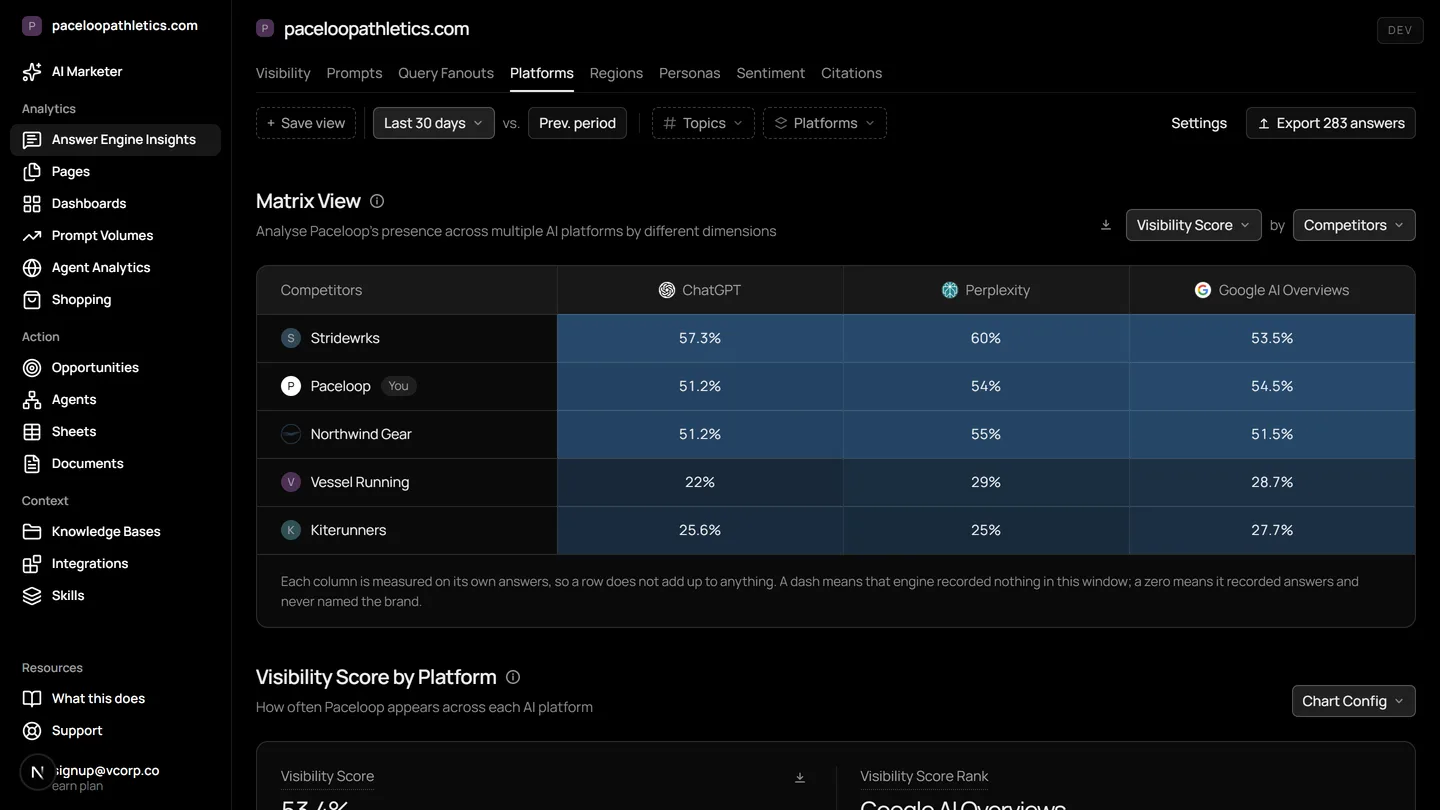
ChatGPT vs Gemini vs Perplexity brand visibility is the practice of measuring how a company is mentioned and cited differently across the major answer engines. Mentionry is an AI marketing platform that records these differences daily, showing your visibility score, share of voice, and which domains each engine trusts to talk about your brand.
Understand and control your AI presence
Visibility per engine
Score, rank and citation share for each engine separately, with the trend for each.
What each engine trusts
The cited domains differ per engine. See the split, and target the engine that matters to your buyers.
Where it lives in the platform
In the product it is /dashboard/model. On the trial it reads your own site from the first day; on Starter it keeps going, and on Enterprise it runs for every brand you have under one login.
What comparing ChatGPT vs Gemini vs Perplexity brand visibility means
When your buyers ask an AI assistant what to buy, the answer they get depends on which one they use. ChatGPT might cite a different set of sources and make a different recommendation than Gemini or Perplexity.
Comparing brand visibility across these platforms means understanding where your brand appears, how it is described, and which of your content each engine chooses to support its answers. This is the new layer of search marketing, built for a world where the answer is a single paragraph with citations instead of ten blue links.
Why AI visibility by platform matters now
In traditional search, a page ranks for a keyword. In AI search, an engine synthesises an answer from many sources. Your brand might be named in ChatGPT's answer for a key question but completely absent from Google AI Overviews for the same prompt.
This changes the goal from ranking a page to being a trusted source an engine cites. If you only track one engine, you miss where your message is not being heard. Platform comparisons show you which engine your buyers are using and whether you are present there.
How Mentionry compares answer engines
You write the questions your buyers ask. Mentionry puts each question to every answer engine on your plan, once a day. It takes three samples per reading to account for variability.
For each engine, it records the full answer text, every URL cited, every brand named, and the searches the model ran on the way. These records are kept in the Platform Comparisons screen, under the Monitor section of your dashboard.
The screen shows two core views. Visibility per engine displays your score, average rank, and share of voice for each engine separately, with a trend line for each. What each engine trusts shows the split of cited domains, so you can see if ChatGPT prefers academic sources while Perplexity cites more commercial blogs.
How to use platform comparisons in your week
Open the Platform Comparisons screen from your dashboard. Start by filtering for a core topic, like 'project management software for remote teams'. Look at the visibility score for each engine. If your brand is strong in ChatGPT but missing from Gemini, that is your gap.
Next, click into the 'What each engine trusts' view for that topic. See which of your own pages are cited by each engine. You might find your case studies are used by Perplexity, but your blog posts are never opened by Google AI Overviews. This tells you what content to refine.
Finally, set a filter to show only prompts where a key competitor is named. Compare the sentiment description each engine gives for your brand versus theirs. This reveals how your competitive positioning shifts depending on the AI assistant a buyer uses.
How to read the numbers and avoid traps
A change in your visibility score for one engine means the frequency of your brand being named in its answers has changed. It does not mean your website traffic will change, because the user may never click through.
A high share of cited domains from your own site is good for control, but a healthy mix of earned citations from third parties signals broader authority to the engine. Do not aim for 100 percent owned citations.
Remember that measurement is only of your own tracked prompts. Mentionry cannot see what other people type into ChatGPT. A zero score means your brand was not mentioned in your tracked questions, not that it is never mentioned.
What platform comparisons does not do yet
The feature shows differences across the engines you track. It does not yet provide proactive alerts outside of a scheduled agent, so a sudden drop in one engine will not ping you unless you have set up an agent to watch for it.
It also does not include data from every AI engine. Microsoft Copilot, Grok and DeepSeek are listed on the Enterprise plan but are not yet live for tracking. Never assume your brand is being measured in those until they are officially released.
Plans and engines you can compare
The free trial runs for seven days on your own site, with 50 prompts a day put to ChatGPT, Gemini and Google AI Overviews. The Starter plan is $99 a month, reading those three engines daily for one brand.
The Enterprise plan is quoted individually. It can include up to nine answer engines, such as Claude and Perplexity, with more prompts, regions, and seats. Recording begins the day you add a prompt, there is no historical backfill.
Questions
Because they search differently and read differently. Query Fanout shows the searches each ran and Citations shows the pages each read.
Get your brand mentioned by the answer engines
Reach millions of consumers who are using AI to discover new products and brands. The first 7 days are free and take no card; Starter is $99 a month after that, and Enterprise is tailored.